
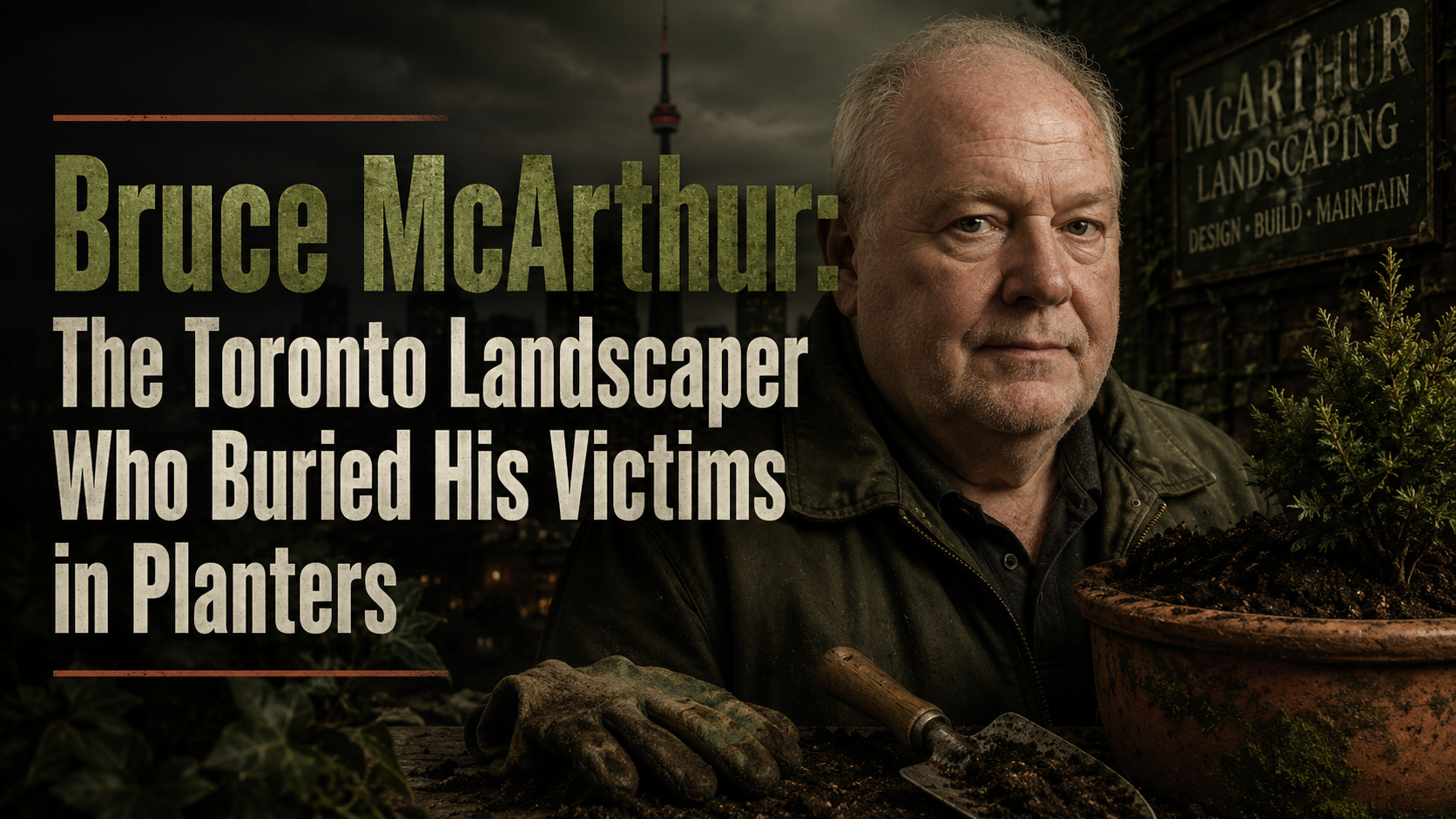
Bruce McArthur: The Toronto Landscaper Who Buried His Victims in Planters
Jun 16
3 min read
Updated: Jun 25
To those who knew him, Bruce McArthur was a jovial, white-bearded grandfather who worked as a landscaper and moonlighted as a shopping-mall Santa. Beneath that genial surface was one of the most disturbing serial killers in Canadian history, a man who murdered eight people over seven years and concealed their dismembered remains in the planters of his own gardening business.
This article examines McArthur's victims, the literal burial ground he created, the warnings that went unheeded, and the investigation that finally stopped him.

Key Facts at a Glance
Full name: Thomas Donald Bruce McArthur
Born: 8 October 1951, Lindsay, Ontario, Canada
Occupation: Self-employed landscaper; part-time mall Santa
Victims: Eight men, killed between 2010 and 2017
Arrested: 18 January 2018
Sentence: Life imprisonment, no parole for 25 years (2019)
The Hidden Life of a Mall Santa
McArthur frequented the bars and clubs of Church and Wellesley, Toronto's LGBTQ village. Acquaintances described him as kind, generous and unremarkable — the last person they would have suspected. That ordinariness was central to how he operated, allowing him to move through the community and select victims without raising alarm.
Eight Men from the Village
Between 2010 and 2017, McArthur murdered eight men, most of them with ties to the Village and many of them immigrants from South Asia or the Middle East:
Skandaraj Navaratnam, Abdulbasir Faizi and Majeed Kayhan (who disappeared between 2010 and 2012)
Soroush Mahmudi, Dean Lisowick and Kirushna Kanagaratnam
Selim Esen and Andrew Kinsman (who disappeared in 2017, and whose cases finally broke the investigation open)
Prosecutors said the killings involved sexual assault or confinement, were premeditated, and that McArthur kept jewellery and other items from his victims as souvenirs.
The Planters
McArthur's method of disposal was as chilling as the murders. He dismembered several victims and hid their remains in large planter boxes at a Leaside property he used to store equipment for his landscaping business — the same planters he tended as part of his ordinary work. Investigators eventually recovered the remains of seven victims from those containers, and an eighth nearby.
Years of Warnings Ignored
Members of the LGBTQ community had voiced fears of a predator targeting the Village for years. An initial police project in 2012 examining a cluster of disappearances did not produce an arrest. The Toronto Police Service was later sharply criticised over allegations of indifference toward missing people who were marginalised, immigrants or struggling, and faced internal and external reviews.
There had been a near-miss. In 2016 McArthur was arrested after allegedly trying to strangle a man in his van, yet he was released and not charged — an episode later seen as a missed opportunity to stop him sooner. Those who knew him struggled to reconcile the friendly figure they thought they knew with the killer revealed in court; one woman at whose home the remains were hidden spoke of “Bruce A and Bruce B,” two seemingly separate men in the same body.
Arrest and Guilty Plea
McArthur was arrested on 18 January 2018; officers found another man bound in his apartment, almost certainly saving that man's life. Searches of the properties where he worked uncovered the hidden remains. On 29 January 2019 McArthur pleaded guilty to eight counts of first-degree murder, sparing the community a long trial. He was sentenced to life with no chance of parole for 25 years.
Aftermath
The case reshaped policing in Toronto. In its wake the force created a dedicated missing-persons unit and confronted hard questions about how concerns from vulnerable communities are taken seriously. For the Village, the relief of an arrest was inseparable from grief and anger that the danger had been dismissed for so long.
A Reckoning for the Police
The McArthur case forced a reckoning within Toronto policing. For years, members of the city's LGBTQ community had warned that a predator was targeting the Gay Village, but an earlier police project examining a cluster of disappearances had closed without an arrest, and McArthur himself had reportedly been questioned and released after a 2016 incident. Following his 2018 arrest, an independent review led by a former judge examined how the force handled missing-persons cases involving marginalised people, and the service later established a dedicated missing-persons unit. For many in the community, the relief of an arrest was inseparable from anger that the danger had been dismissed for so long.
Watch: Full Documentary
Sources & Further Reading
Read Also
Colin Ireland: The London 'Gay Slayer'
Manuel Delgado Villegas: Spain's 'El Arropiero'
Gilbert Paul Jordan: The 'Boozing Barber'


Comments