
The Butcher of Delhi: Chandrakant Jha's Taunting Notes
May 29
6 min read
Updated: Jun 2
Most killers work to stay hidden. This one did the opposite. He delivered his crimes to the gates of one of India's largest prisons, wrapped with a handwritten note that dared the police to catch him before he killed again. The taunt was the point, and it made Chandrakant Jha one of the most chilling figures in the country's criminal history.
The press called him the Butcher of Delhi. His case is unsettling not only for what he did, but for how openly he did it, turning a series of murders into a public game of provocation against the very system meant to stop him. He wanted an audience, and in the end he got a global one.
A migrant among migrants
Born in 1967 in Madhepura, in Bihar, Jha migrated to Delhi around 1990 and settled near the sprawling Azadpur wholesale market, one of the largest of its kind in Asia. He lived among the city's vast population of migrant labourers, young men who had come from elsewhere in search of work and who often had few connections in the capital. It was from this world that he drew both his companions and his victims.
Jha befriended these men, sometimes housing them, sharing meals, offering the kind of help that a newcomer to a hard city desperately needs. He built exactly the bonds of trust that made his later betrayals possible. The relationships looked, from the outside, like the ordinary solidarity of people far from home leaning on one another. That ordinariness was the disguise, and the trust was the trap.
These men were, in a grim sense, ideal victims. Migrant labourers without strong local ties could vanish without anyone raising an immediate alarm. Families were far away, sometimes in other states, and might wait a long time before realising that a son or brother had stopped writing or sending money. The city absorbed their disappearance with barely a ripple.

Killing over the smallest things
What turned acquaintance into murder was, disturbingly, often trivial. Jha is reported to have killed over petty matters and perceived moral failings, disputes about lying, stealing, drinking, or habits he disapproved of. He appointed himself the judge of the men he had befriended, holding them to a private code, and the sentences he handed down for breaking it were lethal.
There is something especially disturbing in this self-righteous logic. Jha did not kill for money or in obvious rage; he killed, by his own framing, to punish. He cast his victims as wrongdoers and himself as the one entitled to pass judgment, a moral inversion that let him present brutal murders, in his own mind, as something like justice.
His killings stretched from 1998 to 2007. After his first murder in 1998 he was arrested and held in jail until 2002, when he was released for lack of evidence, and he resumed killing after his release. The cycle of crime, detention and release would repeat, and each time the gaps in the case, the missing evidence, the unidentified victims, let him slip back into the city to kill again.
The notes at the prison gate
What set Jha apart was his theatricality. He dismembered his victims and left their remains near Tihar Jail, accompanied by notes that mocked the police, challenged them to identify the dead, and dared them to catch him before his next killing. He was not merely committing murders; he was staging them, forcing investigators into a contest on his terms.
The choice of location was its own message. By leaving bodies at the gates of Tihar, one of the largest prison complexes in the world, he was taunting the entire apparatus of law and punishment, depositing his work on the doorstep of the institution built to contain men like him. It was an act of contempt as much as concealment, or rather the deliberate opposite of concealment.
This signature transformed the case from a series of disappearances among an overlooked population into a public spectacle. The notes guaranteed attention, and they revealed a killer who craved the confrontation, who wanted the authorities, and the public, to know that the bodies were his work and that he had so far gone uncaught.
Caught, convicted, and back on the run
Jha was eventually arrested and prosecuted. He was convicted in three of the murders and is suspected of more, with estimates of his total victims running higher than the cases formally proven. The courts initially handed him death sentences that were later commuted to life imprisonment. The man who had taunted the police from outside Tihar ended up imprisoned within the very system he had mocked.
His notoriety was renewed in 2022, when his case became the subject of the Netflix true-crime series Indian Predator: The Butcher of Delhi, introducing his story to a global audience and turning a domestic horror into international true-crime entertainment. Years later he again made headlines after reportedly violating the terms of a parole, a reminder that the case has never fully closed in the public mind.
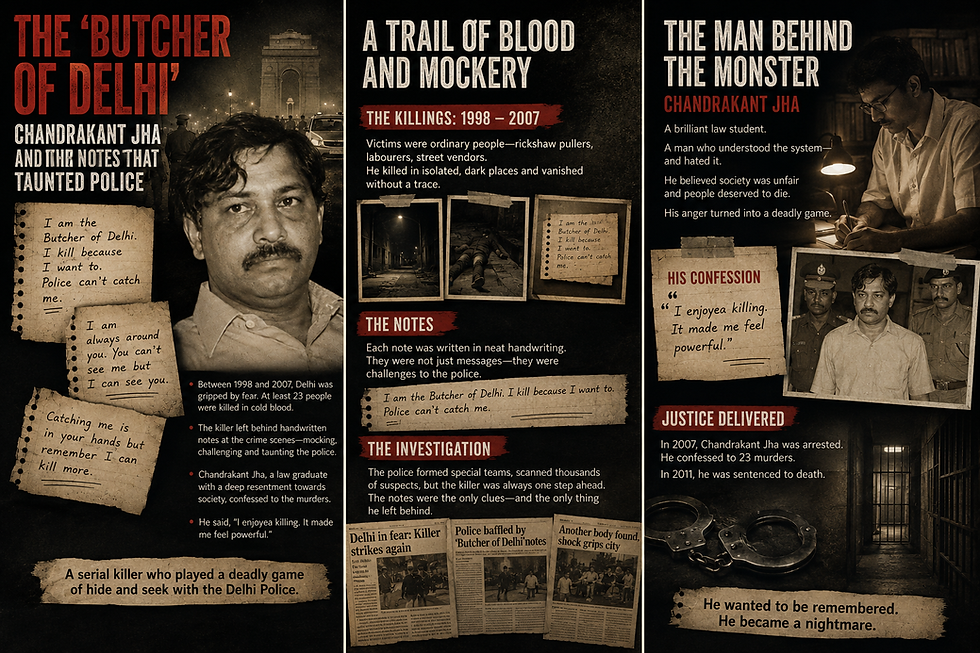
What the taunts really tell us
Jha is a textbook example of how a distinctive signature amplifies a case far beyond its body count. The notes at the prison gate were, in a grim sense, a form of self-promotion, guaranteeing that his crimes would be remembered, dramatised and retold for years. The very behaviour that should have helped catch him, the compulsion to communicate, also made him famous, and arguably it was the attention itself that he was after.
But there is a quieter tragedy beneath the spectacle. His victims were migrant workers, men whose absence might otherwise have gone unremarked in a city of millions. Jha understood that, and chose accordingly. The theatrics drew the cameras; the victims, in life, had drawn almost no attention at all, and even in death they risked being overshadowed by the showmanship of the man who killed them.
That is the uncomfortable balance any responsible retelling must hold. The notes and the nickname make Jha memorable, but the real weight of the story belongs to the young men who came to Delhi looking for work and were killed by someone they had been led to trust. Their names deserve to outlast his theatrics.
Frequently Asked Questions
Why was Chandrakant Jha called the Butcher of Delhi?
The nickname came from his method and his signature. He dismembered his victims and left their remains near Tihar Jail, often with taunting notes addressed to the police, earning him the title the Butcher of Delhi in the press.
Who were his victims?
His victims were mostly migrant labourers in Delhi whom he had befriended. He reportedly killed them over petty disputes or behaviours he disapproved of, such as lying, stealing or drinking.
How many murders was he convicted of?
He was convicted in three murders and is suspected of several more. The courts initially sentenced him to death, later commuted to life imprisonment.
Is there a documentary about him?
Yes. His case is the subject of the 2022 Netflix true-crime series Indian Predator: The Butcher of Delhi, which brought his story to a wide international audience.
When did Chandrakant Jha's killings take place?
His killings spanned from 1998 to 2007. After his first murder in 1998 he was arrested but released in 2002 for lack of evidence, then resumed killing until his final arrest in 2007.
Why did he leave bodies near Tihar Jail?
The location was a deliberate taunt. By dumping remains at the gates of one of the world's largest prison complexes, he was mocking the entire system of law and punishment built to contain men like him.
Why were migrant labourers his targets?
Migrant workers often had few local ties, with families far away in other states. They could disappear without anyone raising an immediate alarm, which is why Jha deliberately chose them.
How did he gain his victims' trust?
He befriended migrant men, sometimes housing them, sharing meals, and helping them find work — building the bonds of trust that made his later betrayals possible.
Was he ever released after his conviction?
He was reportedly granted parole in 2023 but absconded, violating its terms. He was later re-apprehended by Delhi's Crime Branch while serving life imprisonment in three murder cases.
What is the deeper lesson of his case?
His theatrical notes made him famous, but the real weight of the story belongs to the migrant workers he killed — young men who came to Delhi for work and deserve to be remembered beyond his showmanship.
Sources: Delhi court records, contemporary press reporting, and the Netflix documentary Indian Predator: The Butcher of Delhi. He was convicted in three murders and is suspected in several more.


registro Afun lo vi de rebote y entré más por chusmear cómo estaba hecho que por registrarme en serio. Me gustó que el alta no te hace perder tiempo: te piden lo básico (usuario, contraseña y el tema del móvil con el código) y ya vas entendiendo qué sigue sin comerte un texto eterno. También está bueno que te tiren el aviso de no usar datos sensibles como nombre de usuario, porque a veces eso queda escondido y acá lo ves al toque. En general se siente bastante “limpio”, con los campos separados y sin pantallas raras. Lo que más noté es que la info del registro está en bloques cortos con encabezados simples y el formulario queda bien ordenado.
link vào jd88 là mình nhấp thử cho biết thôi, tại thấy mấy người nhắc dạo này nên tò mò xem giao diện ra sao. Mình không có đọc kỹ nội dung hay ngồi tìm hiểu từng mục đâu, chỉ lướt nhanh vài phút để xem họ trình bày có dễ nhìn không. Cảm giác đầu tiên là trang nhìn khá thoáng, không bị nhồi chữ, các phần được chia thành từng khối nên mắt đỡ mệt khi kéo xuống. Mình cũng để ý cái menu đặt khá dễ thấy, bấm qua lại mấy chỗ không phải mất công mò. Nói chung kiểu thiết kế này hợp ai thích mọi thứ rõ ràng, nhìn phát nắm được ý. Kéo xuống…