
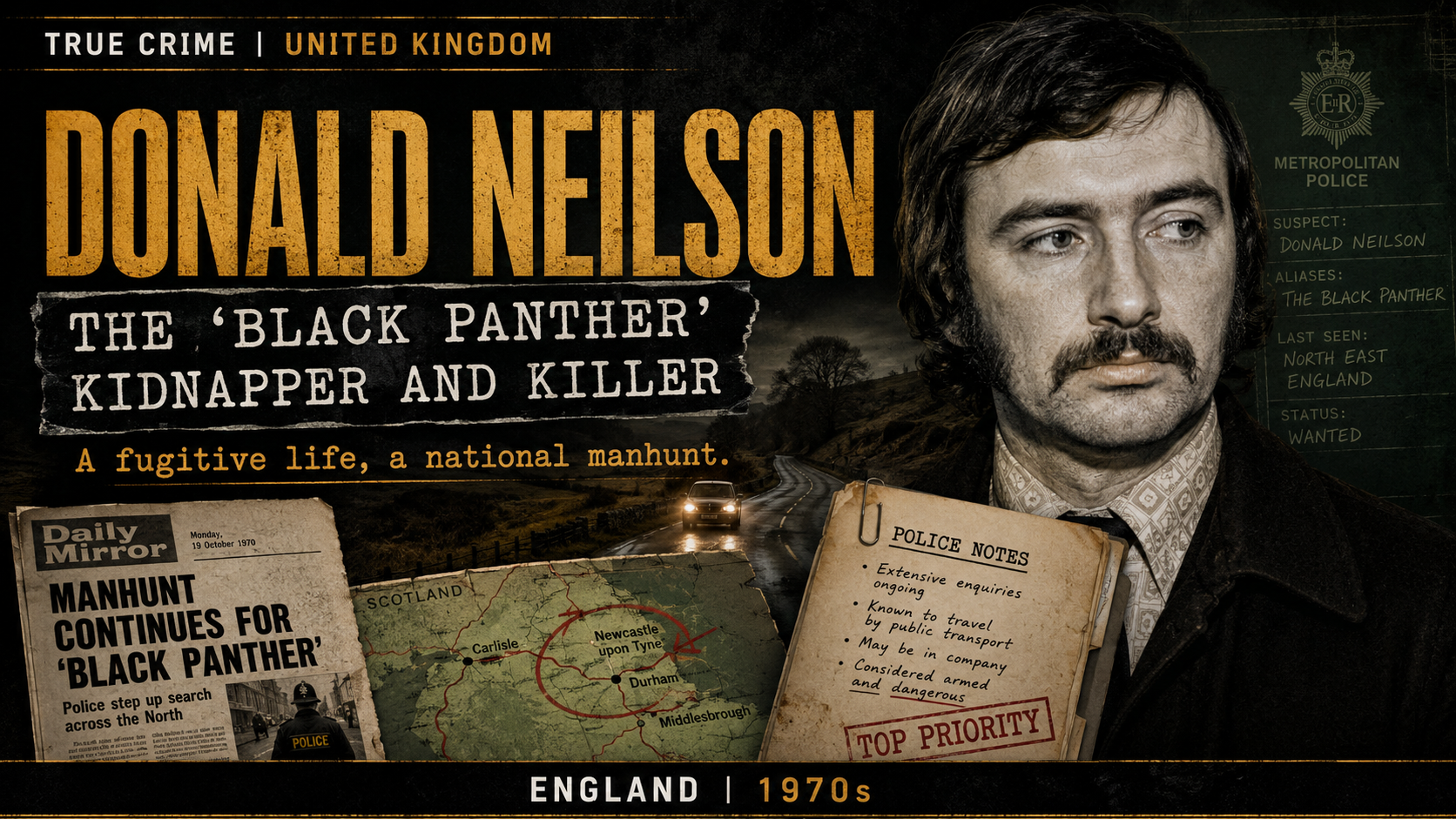
Donald Neilson: The 'Black Panther' Kidnapper and Killer
Jun 18
3 min read
Donald Neilson, nicknamed 'The Black Panther' for the dark hood he wore during his raids, terrorised Britain in the early 1970s, murdering three sub-postmasters during armed robberies before escalating to the kidnapping and death of teenage heiress Lesley Whittle. This account avoids graphic detail out of respect for the victims.
A former soldier with a meticulous, militaristic approach to his crimes, Neilson eluded police for years until a chance encounter brought his reign of fear to an end.

Key Facts at a Glance
Full name: Donald Neilson (born Donald Nappey)
Born: 1 August 1936, Bradford, England
Known as: The Black Panther
Crimes: Three post office murders; the kidnap-murder of Lesley Whittle
Caught: December 1975, after a chance confrontation
Outcome: Life imprisonment; died in 2011
From Soldier to Armed Robber
Neilson served in the British Army during his national service, an experience that left him with a fascination for weapons, discipline and planning. In civilian life he struggled financially, working odd jobs while nursing resentment and ambition.
He turned to burglary and then to armed robbery of sub-post offices, applying a soldier's preparation to his raids and wearing a distinctive hood that would give him his nickname.
The Post Office Murders
Between 1971 and 1974, Neilson shot and killed three sub-postmasters during robberies across the Midlands and the north of England. The killings were marked by sudden, decisive violence when victims resisted or startled him.
Police struggled to connect the crimes at first, and the unidentified, hooded raider became the subject of one of the largest manhunts of the era.
The Kidnapping of Lesley Whittle
In 1975 Neilson escalated dramatically, abducting Lesley Whittle, a 17-year-old heiress, from her home in Shropshire and demanding a ransom. He held her in an underground drainage shaft at Bathpool Park.
The ransom plan collapsed amid confusion and police involvement, and the case ended in tragedy. The kidnapping transfixed the nation and intensified the hunt for the Black Panther.
A Chance Capture
Neilson's capture in December 1975 owed much to luck. Two police officers on patrol stopped a man behaving suspiciously near a post office, and after a violent struggle they subdued and detained him.
Once in custody, evidence quickly linked him to the Black Panther crimes, ending years of fruitless searching with an almost accidental arrest.
Trial and Imprisonment
In 1976 Neilson was convicted of the murders of the three sub-postmasters and of Lesley Whittle, along with numerous other offences. He was sentenced to life imprisonment.
He remained behind bars for the rest of his life, his tariff later confirmed as a whole-life term, and he died in custody in 2011.
Legacy of the Manhunt
The Black Panther case became a landmark in British policing, exposing the difficulties of coordinating investigations across multiple force areas before modern information-sharing. The handling of the ransom, in particular, was heavily scrutinised.
Decades on, the case remains a touchstone in discussions of kidnapping investigations and inter-force cooperation, and a byword for the terror a single determined offender can spread.
Lessons From the Investigation
The hunt for the Black Panther exposed real weaknesses in 1970s British policing, particularly the difficulty of linking crimes committed across different force areas before the era of shared computer databases. For years, the post office shootings and the kidnapping were handled by separate teams who struggled to pool what they knew.
The handling of the Lesley Whittle ransom, in particular, was heavily criticised and studied afterward, prompting reforms in how police manage kidnapping cases and coordinate between regions. Neilson's military-style planning and use of disguise also made him a case study in how a methodical, disciplined offender can frustrate even a large-scale manhunt.
Remembering the Victims
Behind the Black Panther headlines lay real and devastating loss, above all the death of Lesley Whittle, a teenager whose abduction and fate horrified the country. The three sub-postmasters who died were ordinary working people going about their daily lives.
Decades later, the case is still remembered as one of the most chilling of its time, and the names of the victims remain a sombre reminder that the terror Neilson spread was measured first and foremost in the lives he destroyed.


Comments