
Dorothea Puente: The 'Death House Landlady'
Jun 5
3 min read
Updated: Jun 18
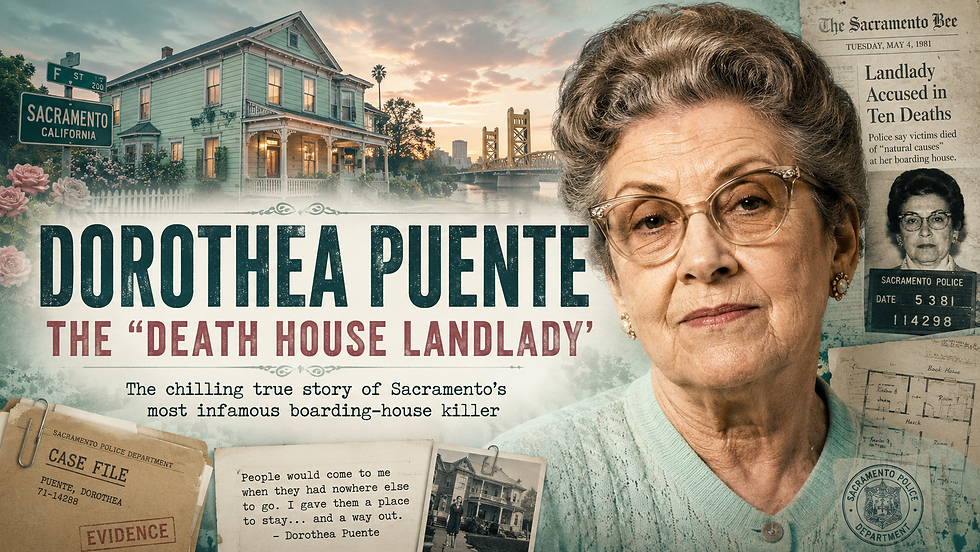
She looked like everyone's idea of a kind grandmother — silver-haired, soft-spoken, the sort of landlady who would take in the people no one else would. That image was Dorothea Puente's most powerful weapon.
At her boarding house in Sacramento in the 1980s, she murdered vulnerable tenants, buried them in the garden, and went on cashing their government checks. By the time anyone dug up the yard, the 'Death House Landlady' had left a row of graves beneath her tidy flowerbeds.
A deceptive caregiver
Born in California in 1929, Puente had a long history of deception well before the murders, including convictions tied to forgery and to drugging people in order to rob them. She had, at one point, been barred as a condition of probation from handling government checks or caring for the elderly.
She ignored all of it. By the 1980s she was running a boarding house at 1426 F Street and presenting herself as a compassionate landlady willing to house 'hard to place' tenants — alcoholics, the elderly, the disabled, people other facilities turned away.
Preying on the vulnerable
Her victims were chosen precisely because they were easy to overlook: socially isolated, often without close family, and dependent on government assistance. That dependence was the entire point.
Once a tenant was dead, Puente could keep collecting their benefit checks, and few people were likely to notice the absence of someone the world had already forgotten. Her nurturing reputation — she was known for cooking and keeping a neat home — was the perfect cover for theft and murder.
The method
Investigators determined that Puente drugged and killed her tenants, then had their bodies buried in the yard of the Victorian house. For a time the scheme ran smoothly: the checks kept arriving, and she kept up the appearance of a caring landlady, even as the number of bodies hidden in her garden quietly grew.
The investigation and the escape
Suspicion arrived in 1988, when a social worker, Judy Moise, reported a tenant — a developmentally disabled man named Alvaro Montoya — missing. Police came to dig in the yard, with Puente's seemingly cooperative consent, and unearthed human remains, and then more, seven bodies in all on the small property.
In a much-criticised lapse, Puente slipped away during the early stage of the search, telling officers she was going to a nearby hotel. She fled to Los Angeles, where she reportedly began befriending another elderly man — until he recognised her from news coverage and tipped off police, and she was arrested within days.
Trial and death
Puente was tried and, in 1993, convicted of three murders, with the jury deadlocking on the other counts. She was sentenced to life in prison without the possibility of parole, maintaining her innocence to the end. She died behind bars in 2011, aged 82. Her case endures as a disturbing study of how a predator can hide inside the role of caregiver, and of how easily society's most invisible members — the old, the poor, the disabled — can be exploited when no one is paying attention.
Frequently Asked Questions
How many people did Dorothea Puente kill?
She is linked to nine murders and was convicted of three, committed at her Sacramento boarding house in the 1980s.
What was her motive?
She killed elderly and disabled tenants in order to steal and keep collecting their government benefit checks.
What happened to Dorothea Puente?
She was convicted in 1993 and sentenced to life without parole, and died in prison in 2011 at the age of 82.


Comments