
Mohammed Bijeh: The Pakdasht Child Murders
Jun 5
3 min read
Updated: Jun 18
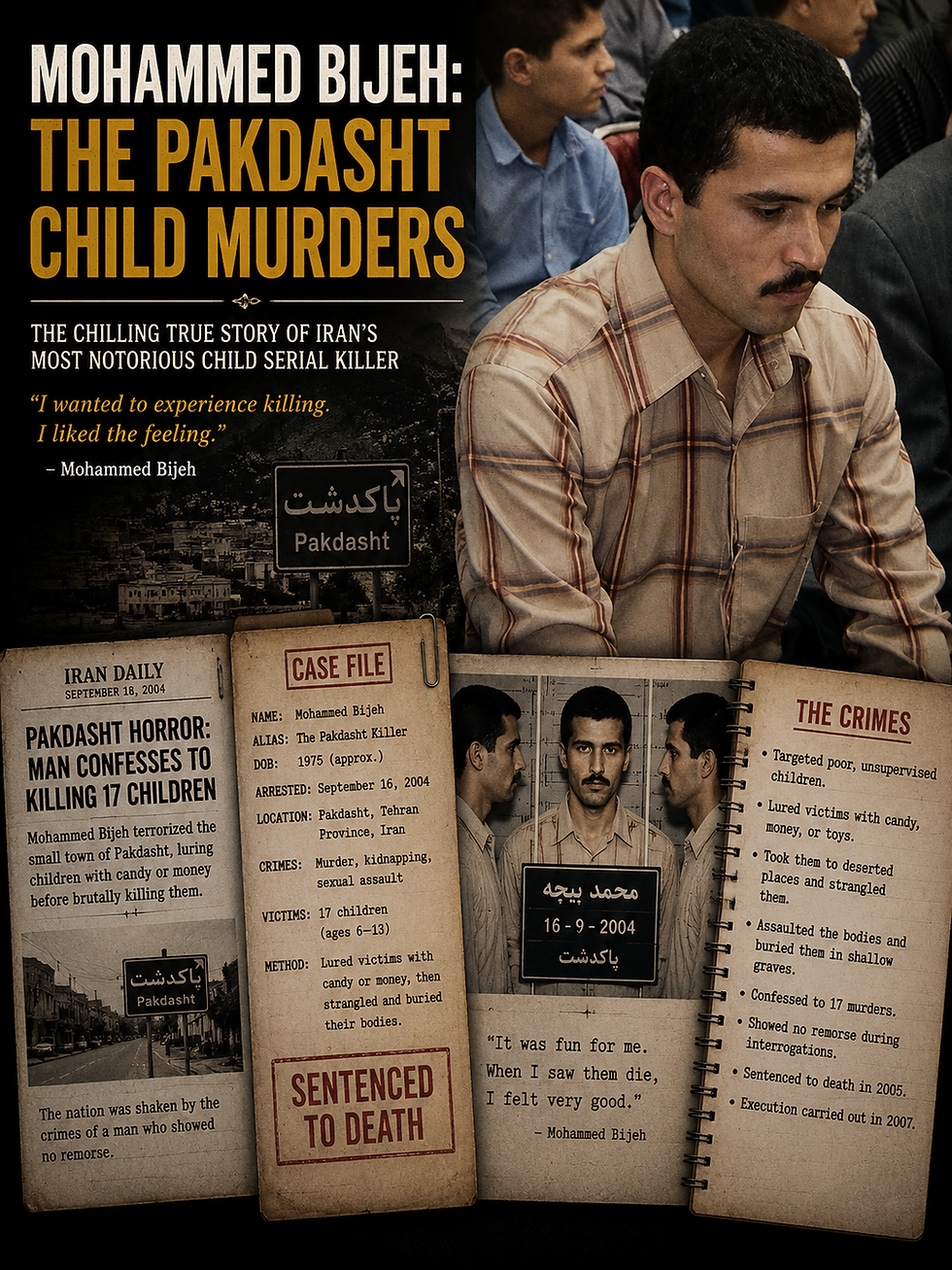
The case of Mohammed Bijeh, whom the Iranian press sensationally dubbed the 'Desert Vampire', stands among the most disturbing criminal cases in modern Iranian history. Convicted of abducting and murdering around twenty children in the desert near Pakdasht, south of Tehran, in 2004, his crimes are remembered not only for their horror but for the chain of social failures that allowed them to continue for months. This account focuses on the documented facts, on the vulnerability of the victims, and on what the case exposed, without dwelling on graphic detail.
More than the lurid nickname, it is the ordinariness of the conditions that enabled the crimes — poverty, fear, official neglect — that gives the Bijeh case its lasting and uncomfortable weight.
A desperate region
Bijeh operated on the impoverished desert fringes south of Tehran, an area dotted with informal settlements and refugee communities and home to many families living precariously on the margins of Iranian society. He himself came from a background of hardship. The setting matters enormously to the case: this was a place where families had little security and little reason to trust the authorities, and where a predator could exploit both the empty terrain and the desperation of the people living around it.
The crimes
Over roughly half of 2004, Bijeh lured children — mostly boys — away from their communities, typically by offering to take them out into the desert to hunt animals, a proposition that appealed to bored and impoverished youngsters. Once he had isolated them far from any help, he killed them and concealed their bodies in the remote terrain. As one child after another failed to return over the course of months, a creeping fear took hold of the local population, even as the wider world remained unaware.
Why it went on so long
A central tragedy of the case is the question of why it continued for so many months. Many of the victims came from poor Afghan refugee families who feared that contacting the Iranian authorities might lead to their deportation, and as a result a number of the missing children were never formally reported at all. Compounding this, the police investigation was later sharply criticised as negligent; Bijeh had even been briefly detained at one point and released for lack of evidence, a failure that allowed the killings to go on.
The victims, in other words, fell into a terrible gap — too marginal to be searched for, too feared of the state to seek its help — and Bijeh exploited that gap with devastating effect.
Arrest and trial
Bijeh was finally caught after intended victims escaped and reported him, and as investigators recovering bodies from shallow desert graves began to connect the cases into a single, horrifying pattern. He confessed during a trial that was held largely in private, out of consideration for the grieving families. He was convicted of the murders, while an accomplice received a lengthy prison sentence for related offences. The proceedings laid bare both the scale of the crimes and the failures that had preceded their discovery.
A controversial execution
In March 2005, Bijeh was publicly executed in Pakdasht before a large crowd, in scenes that drew international attention and considerable unease. The spectacle of the execution — and the presence of onlookers, including children — fuelled a wider debate, both inside and outside Iran, about the use of public executions, a debate that ran quite separately from the horror of the crimes themselves. For many observers, the case raised hard questions about justice, punishment and dignity all at once.
Beyond the lurid nickname the press attached to him, the lasting significance of the Bijeh case lies in its lessons about how poverty, the precarious status of refugee families, and institutional negligence can combine to leave the most vulnerable children unprotected. Remembering those children, and confronting the systemic failures that endangered them, matters far more than the notoriety of the man who harmed them — and it is the part of this story that should never be lost to sensationalism.
Frequently Asked Questions
Who was Mohammed Bijeh?
An Iranian man convicted of abducting and murdering around 20 children in the desert near Pakdasht, south of Tehran, in 2004.
Why were the disappearances not reported sooner?
Many victims came from poor Afghan refugee families who feared deportation if they contacted the authorities, which delayed the investigation.
What happened to Bijeh?
He was convicted in 2004 and publicly executed in March 2005, a case that fuelled debate over public executions in Iran.


Comments