
The Nithari Case: The Killings That Horrified India, and the Acquittal That Stunned It
Jun 3
5 min read
For seventeen years it was spoken of as one of the most monstrous crimes in India's history, a case so dark it became shorthand for evil itself. And then, in a single court ruling, the foundation beneath it gave way. A high court looked at the evidence that had sent a man toward the gallows and concluded that, in truth, it had never really been there.
The Nithari case is essential reading for anyone who studies true crime, but not only for the horror at its centre. It is essential because of how it ended, and because of what that ending says about confessions, investigations, and the danger of certainty. It is a story that turns the usual true-crime satisfaction, the catching of the culprit, completely inside out.
The discovery that shocked a nation
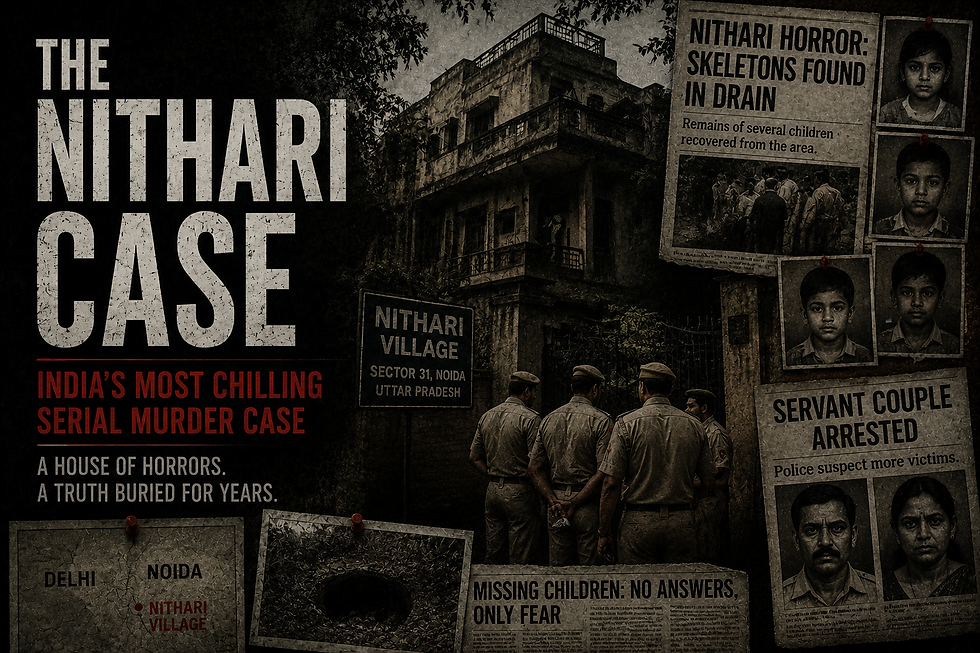
In 2006, in the Nithari area of Noida, on the outskirts of Delhi, the skeletal remains of victims, many of them children, were discovered in and around a drain behind a house. The neighbourhood, a poor locality whose families had reported children going missing over a long period, had its worst fears confirmed all at once. The discovery was gruesome, and the public reaction was immediate and furious.
Suspicion fell on two men: Surinder Koli, who worked as a domestic servant at the house, and Moninder Singh Pandher, the businessman who owned it. The allegations that emerged were among the most lurid the Indian press had ever reported, encompassing claims of sexual assault, murder, dismemberment and even cannibalism. The case became a national symbol of horror, and Koli in particular was convicted and sentenced to death in multiple separate cases over the following years.
For a long time, the guilt of the accused, especially Koli, was treated by the public as established fact. The story had everything a horror narrative demands: a house of death, vulnerable child victims, and a monstrous servant. It was repeated, dramatised and absorbed into the national memory as a settled case.
A prosecution built on shaky ground
But beneath the certainty, the case rested on foundations that would not hold. Much of it depended on confessions rather than robust, independent evidence. Koli's confession, in particular, was central, and serious questions hung over the circumstances in which it was obtained and how much weight it could truly bear.
Critics and, ultimately, the courts pointed to a deeply flawed investigation. There were allegations that the initial police response to the missing-children complaints from a poor neighbourhood had been slow and indifferent, that the crime scene and evidence had been mishandled, and that obvious investigative avenues, including questions about the possible involvement of an organ trade, were never properly pursued. In a system where a confession can carry enormous weight, these were not technicalities. They went to the heart of whether the truth had ever actually been established.
The reliance on confession is a recurring danger in criminal justice everywhere. A confession feels like certainty, like the case closing itself. But confessions can be unreliable, obtained under pressure, or simply wrong, and when an investigation leans on them in place of physical evidence, it builds its conclusions on sand.
The acquittal that stunned everyone
In October 2023, seventeen years after the remains were found, the Allahabad High Court acquitted both Koli and Pandher of the charges against them. The court cited the lack of convincing evidence beyond the confessions and pointed to the serious failures of the investigation. The men who had been treated for nearly two decades as among India's most notorious killers were cleared.
The ruling sent a shock through the public, precisely because the case had felt so settled. For seventeen years the narrative had been fixed; now the court was saying that the evidence underpinning it could not support a conviction. It was a reversal almost without parallel in the public's memory of Indian crime.
The acquittal did not, and could not, undo the underlying tragedy. Children had gone missing and families had been shattered; that much was painfully real. What the ruling declared was something different and equally grave: that the case the state had built to explain that tragedy could not bear legal scrutiny, and that the question of who was truly responsible may now never be answered. The families were left not with closure, but with a void where certainty had once seemed to be.
Why this case belongs in every true-crime library
Nithari is now studied as much for the failures around the crime as for the crime itself. It is a cautionary tale about confession-based convictions, about the pressure to deliver a culprit when public horror demands one, and about how a flawed investigation can produce years of apparent certainty that later collapses entirely.
It also exposes a class dimension that runs through many such cases. The victims were the children of poor, working families whose early reports of disappearances were allegedly not taken seriously. The same indifference that may have let the crimes continue also shaped an investigation that ultimately could not deliver reliable answers. Justice failed these families twice: first in prevention, then in resolution.
For anyone who writes about real crime, the case carries a specific warning. The most dramatic narrative, the one the public seizes on and the headlines amplify, is not always the one the evidence supports. Responsible true crime has to hold space for doubt, for the possibility that the official story is wrong, and for the victims whose actual fate may have been lost in a rush to judgment.
It is a difficult note on which to end a collection like this, and that is precisely why it matters. The genre thrives on certainty and resolution, on the reassuring arc of crime, investigation and punishment. Nithari offers none of that. It offers instead a warning about the limits of what we can know, and a reminder that behind every sensational case are real victims who deserve the truth, not merely a satisfying story.
Frequently Asked Questions
What was the Nithari case?
The Nithari case refers to the 2006 discovery of the remains of victims, many of them children, near a house in Noida, on the outskirts of Delhi. It became one of India's most notorious crime cases, centring on the home's owner, Moninder Singh Pandher, and his servant, Surinder Koli.
Were Surinder Koli and Moninder Singh Pandher convicted?
Initially, yes. Koli was convicted and sentenced to death in multiple cases, and the case was treated for years as settled. However, in October 2023 the Allahabad High Court acquitted both men of the charges against them.
Why were they acquitted after seventeen years?
The Allahabad High Court found that the case rested largely on confessions rather than convincing independent evidence, and pointed to serious flaws in the investigation. It concluded that the evidence could not support the convictions.
Who was responsible for the Nithari crimes, then?
Following the acquittals, the question remains legally unresolved. The crimes were real and the victims' families suffered genuine loss, but the courts found that the case as prosecuted could not establish who was responsible, leaving the matter without a definitive answer.
Sources: the 2023 judgment of the Allahabad High Court acquitting both accused, and contemporary national press reporting. Because of the acquittals, the question of responsibility for the Nithari crimes remains legally unresolved.


Comments