
Richard Cottingham: Inside the Mind of America’s “Torso Killer”
May 25
7 min read
Updated: Jun 18
For years, the streets of New York and New Jersey hid a terrifying secret. Women were disappearing. Some were later discovered horribly mutilated. Others were never identified at all. Police investigators faced crime scenes so brutal that veteran detectives struggled to describe them publicly. At the center of this nightmare was a seemingly ordinary man named Richard Cottingham — a husband, father, and computer worker who secretly became one of the most disturbing serial killers in American history. Known today as the “Times Square Killer” and “Torso Killer,” Cottingham’s crimes shocked the United States because of their extreme cruelty, sadistic torture, and horrifying mutilations. Even decades after his arrest, new confessions continue to emerge. Investigators believe the true number of victims may never be known.

Who Was Richard Cottingham?
Richard Francis Cottingham was born on November 25, 1946, in the Bronx, New York. To neighbors and coworkers, he appeared quiet and normal. He worked in the computer industry during the rise of modern data systems and lived what looked like an ordinary suburban life in New Jersey. He was married and had children. But behind that ordinary image was a deeply violent predator living a double life. By the late 1960s and throughout the 1970s, Cottingham allegedly began hunting vulnerable women across New York City, especially around the dangerous nightlife districts of Times Square. At the time, Times Square was very different from today. Before the bright tourist attractions and giant LED billboards, the area was infamous for:
Porn theaters
Sex shops
Street prostitution
Drug crime
Organized criminal activity
The environment allowed predators to operate more easily, especially against victims society often ignored.
The Horrifying Modus Operandi

Richard Cottingham’s methods were exceptionally brutal. Investigators discovered patterns in his crimes:
Victims were often approached in Times Square.
Many were taken to hotels or motels.
He frequently used torture before murder.
Some victims were drugged or restrained.
Bodies were mutilated after death.
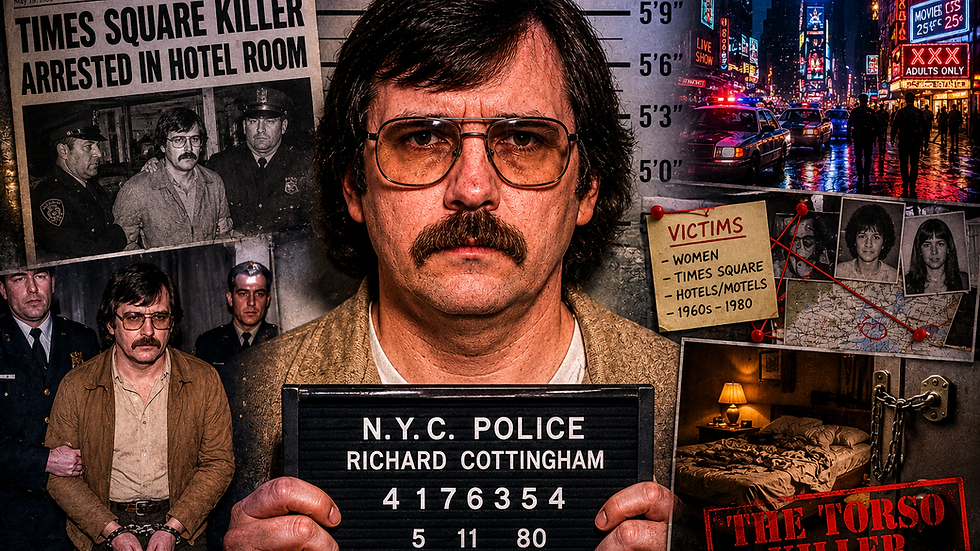
In several infamous cases, victims were decapitated and dismembered. This led investigators to give him the nickname:
“The Torso Killer”
The mutilation often prevented police from identifying victims quickly. In the 1970s, forensic technology was far less advanced than today, making many investigations extremely difficult. Some crime scenes became legendary among detectives because of their sheer brutality. Retired investigators later described the scenes as among the worst they had ever witnessed.
The Fear Spreading Across New York
During the late 1970s, fear spread among sex workers and vulnerable women in New York and New Jersey. Women disappeared under mysterious circumstances. Some were found in hotel rooms. Others were discovered in wooded areas or abandoned locations. Police realized they might be dealing with a serial killer, but connecting cases across different jurisdictions was difficult at the time. Unlike modern investigations:
There were no national DNA databases.
Surveillance cameras were rare.
Digital tracking did not exist.
Communication between police departments was slower.
This allowed killers like Cottingham to continue operating for years.
The Bergen County Murders
One of the most infamous chapters in Cottingham’s crimes occurred in New Jersey. Several victims were discovered in Bergen County motels under horrifying conditions. Investigators noted:
Extreme violence
Torture
Burning injuries
Mutilation
The brutality suggested the killer enjoyed domination and suffering rather than simply killing for convenience. Psychologists later classified many aspects of his crimes as sexually sadistic violence.
The Psychology Behind Richard Cottingham

Criminal profilers studying Cottingham believe power and control were central motivations. Many serial killers murder quickly. Cottingham was different. Evidence suggested he enjoyed:
Fear
Torture
Psychological domination
Prolonged suffering
This level of sadism placed him among America’s most disturbing serial offenders. Experts have compared certain behavioral patterns in his crimes to other notorious killers known for torture-based murders. However, Cottingham’s mutilation of bodies made his crimes especially shocking.
The Night Everything Changed
Despite years of violence, Richard Cottingham almost escaped permanently. But in May 1980, a single event ended his reign of terror. Police officers responded to screams coming from a hotel room in New York City. Inside, they found a horrifying scene:
A young woman was restrained.
She had been brutally assaulted.
She was still alive.
Richard Cottingham was arrested at the scene. That survivor became one of the key reasons authorities were finally able to stop him. Without that moment, investigators believe the killing spree might have continued far longer.
The Trial and Convictions
After his arrest, investigators connected Cottingham to multiple murders through evidence, witness testimony, and forensic investigation. He was eventually convicted in several murder cases and sentenced to life imprisonment. Over the years, more evidence continued emerging. Some cold cases that had remained unsolved for decades were later linked to him through:
DNA evidence
Old investigative files
Confessions
Modern forensic analysis
Shocking Confessions Decades Later
Even while imprisoned, Cottingham continued confessing to murders. These admissions shocked investigators because some cases had remained unsolved for nearly half a century. Authorities reopened old files and discovered that several unidentified victims may have been connected to him. In recent years, he admitted involvement in additional killings dating back to the 1960s. Some investigators now suspect the real victim count could be far higher than the officially confirmed number. Cottingham himself once claimed he killed dozens of women. Whether all those claims are true remains uncertain. But experts believe many unidentified victims may still exist.
Why Richard Cottingham Became So Infamous
Several factors made Richard Cottingham one of America’s most notorious serial killers:
1. Extreme Brutality
The mutilation and torture horrified investigators.
2. Double Life
He maintained the appearance of a normal family man.
3. Long Killing Period
His crimes stretched across many years.
4. Victim Vulnerability
Many victims were marginalized women whose disappearances received limited attention initially.
5. Continuing Confessions
Even decades later, new revelations continue appearing.
The Dark Reality of Serial Killers in the 1970s

The 1970s became known as one of the worst eras for serial murder in the United States. Several factors contributed:
Poor forensic technology
Lack of communication between states
Rising urban crime
Vulnerable populations disappearing unnoticed
During this era, multiple notorious killers operated simultaneously across America. Cottingham became one of the darkest examples of how dangerous this period truly was.
Could Richard Cottingham Have More Unknown Victims?
Many experts believe the answer is yes. Several reasons support this theory:
Some disappearances were never solved.
DNA technology was unavailable during early investigations.
Many victims were never identified.
Cottingham traveled frequently.
He confessed to more crimes than officially confirmed.
Cold case investigators continue reviewing old files connected to his movements. Some families may still not know what happened to missing relatives decades later.
Netflix and the Return of Public Interest
The case gained renewed global attention after the release of:
Crime Scene: The Times Square Killer
The documentary explored:
The dangerous world of 1970s Times Square
Police investigations
Survivor testimony
Cottingham’s psychology
The broader culture surrounding the crimes
The series introduced a new generation to one of America’s most disturbing killers.
The Legacy of Fear
Richard Cottingham’s crimes left permanent scars on investigators, survivors, and victims’ families. Some detectives reportedly never forgot the crime scenes. Others spent decades trying to identify unnamed victims. The case also exposed how society often ignored vulnerable women during that era. Many victims were dismissed simply because they worked in dangerous environments or struggled with poverty and addiction. Today, true crime researchers view the Cottingham investigation as both:
A horrifying serial murder case
A reminder of systemic failures in protecting vulnerable people
Final Thoughts
Richard Cottingham was more than just another serial killer. He represented a terrifying combination of:
Sadism
Secrecy
Intelligence
Opportunity
For years, he moved unnoticed through one of America’s largest cities while living an apparently normal life. Even decades later, investigators continue uncovering new details about his crimes. And somewhere in old police archives, there may still be unidentified victims connected to the man known as the “Times Square Killer.”
Frequently Asked Questions
Who was Richard Cottingham?
Richard Francis Cottingham was born on November 25, 1946, in the Bronx, New York. He worked in the computer industry, was married with children, and lived an outwardly normal suburban life in New Jersey — while secretly committing a series of brutal murders across New York and New Jersey throughout the late 1960s and 1970s.
Why was Richard Cottingham called the Torso Killer?
Because several of his victims were decapitated and dismembered, often leaving only torsos behind. The mutilation also prevented police from quickly identifying victims, and in the 1970s, forensic technology was far less advanced than today.
How many people did Richard Cottingham kill?
The officially confirmed number is smaller, but Cottingham himself claimed to have killed dozens of women. Investigators suspect the real total may be far higher, and unidentified cold-case victims continue to be linked to him through DNA evidence and old investigative files.
How was Richard Cottingham caught?
In May 1980, police officers responded to screams from a hotel room in New York City and found a young woman who had been restrained and brutally assaulted but was still alive. Cottingham was arrested at the scene, and that survivor became one of the key reasons authorities were finally able to stop him.
Is Richard Cottingham still alive?
Yes, Cottingham remains imprisoned in the United States. Even while imprisoned, he has continued to confess to additional murders dating back as far as the 1960s.
What documentary covers the Times Square Killer case?
Netflix released Crime Scene: The Times Square Killer, which examines his murders, the 1970s Times Square environment, police investigations, survivor testimony, and Cottingham's psychology.
Where and when did Richard Cottingham commit his crimes?
Cottingham operated across New York and New Jersey, with his crimes stretching from the late 1960s until his arrest in 1980. He frequently approached victims around Times Square during a period when the area was associated with porn theaters, sex shops, street prostitution, and organized criminal activity.
What was Cottingham’s modus operandi?
Investigators found that he often approached victims in Times Square and took them to hotels or motels, where he frequently used torture before murder, sometimes drugging or restraining them. In several infamous cases the victims were decapitated and dismembered, which is how he earned the “Torso Killer” nickname.
Why did Cottingham avoid capture for so long?
During the late 1970s there were no national DNA databases, surveillance cameras were rare, digital tracking did not exist, and communication between police departments was slower. Because many of his victims were marginalized women whose disappearances received limited attention, he was able to keep operating for years.
What motivated Richard Cottingham according to profilers?
Criminal profilers believe power and control were central motivations. Unlike killers who murder quickly, Cottingham appeared to draw out his crimes — evidence suggested he sought fear, torture, psychological domination, and prolonged suffering, placing him among America’s most disturbing sadistic offenders.
Read Also
Richard Cottingham The Torso Killer


Comments