
The Doodler: The Serial Killer Who Sketched His Victims Before Murdering Them
May 20
5 min read
Updated: Jun 18
A Killer Hidden in the Shadows of San Francisco
In the mid-1970s, fear spread through the streets of San Francisco as a brutal serial killer hunted men connected to the city’s gay nightlife scene.
The murderer became known as The Doodler because of a chilling habit:
He reportedly drew sketches of his victims before killing them.
Despite multiple surviving witnesses, police investigations, and decades of renewed interest, the identity of The Doodler remains one of America’s most disturbing unsolved serial killer mysteries.
The Murders Begin
The killings started in January 1974.
Victims were usually found:
stabbed repeatedly,
dumped in secluded areas,
and connected to bars, clubs, or beaches frequented by gay men.
At the time, San Francisco’s LGBTQ community was growing rapidly, but prejudice and fear made many witnesses reluctant to cooperate with authorities.
Investigators later believed the killer specifically targeted:
white men,
often middle-aged,
who met him in nightlife areas.
Why Was He Called “The Doodler”?
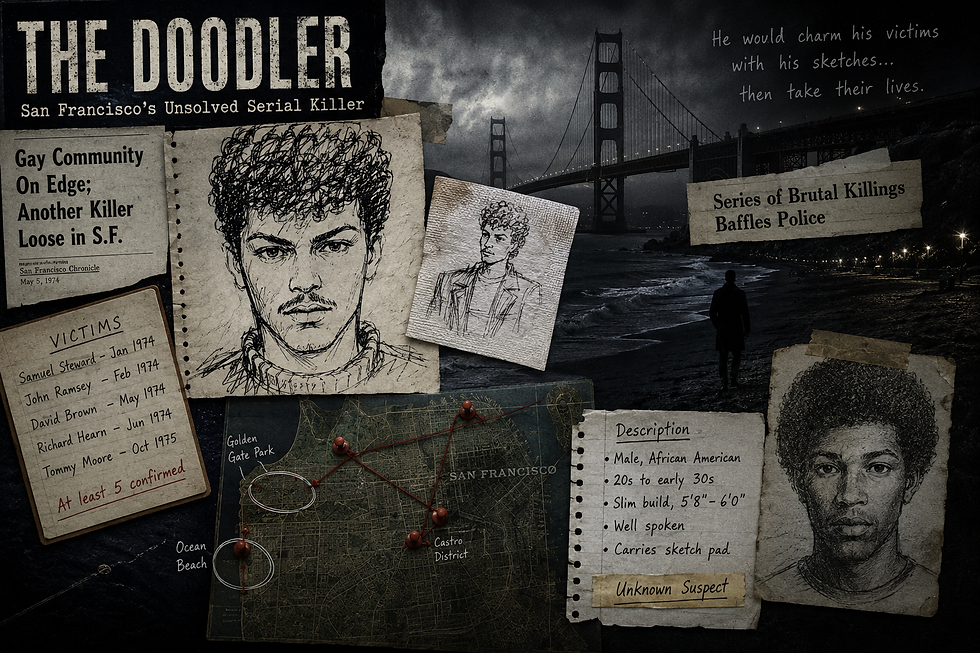
Witnesses described a young African-American man who approached victims in bars and restaurants.
He would:
charm them,
talk casually,
then sketch cartoons or portraits on napkins and paper.
The killer allegedly used these drawings as part of his social approach before luring victims away.
This strange behavior gave birth to the nickname:
“The Doodler.”
The Victims
Police officially linked at least:
5 murders
But investigators later believed the true number may have been:
14 victims or more.
Several victims were well-known professionals, including:
a diplomat,
a drag performer,
and respected members of the community.
Many bodies were discovered near:
Ocean Beach,
Golden Gate Park,
and secluded coastal locations.
The murders shocked San Francisco because of their brutality.
Victims were often stabbed dozens of times.
Survivors Who Escaped the Killer
One of the most terrifying aspects of the case is that:
some victims survived encounters with The Doodler.
A few men reportedly escaped after being attacked.
According to investigators:
at least one survivor identified the suspect,
but refused to testify publicly.
Why?
Because during the 1970s:
being openly gay could destroy careers,
reputations,
marriages,
and public lives.
Police believed this fear may have prevented the killer from being prosecuted.
The Main Suspect
Authorities reportedly identified a suspect in the 1970s.
He was described as:
intelligent,
artistic,
socially awkward,
and deeply troubled psychologically.
Some reports claimed he admitted being present with victims but denied murder.
However:
prosecutors lacked enough evidence,
witnesses would not testify,
and the case collapsed.
The suspect’s name was never officially released.
Was The Doodler a Sexual Predator?
Criminal profilers believe the murders may have involved:
internalized rage,
sexual conflict,
and hatred toward his own identity or victims.
Some experts suggested the killer may have struggled with:
sexuality,
mental illness,
isolation,
or severe emotional trauma.
The extreme overkill in the stabbings suggested intense anger.
Why the Case Went Cold
Several factors damaged the investigation:
1. Fear Within the Community
Many witnesses avoided police.
2. Limited Forensics
DNA technology barely existed in the 1970s.
3. Social Stigma
Victims’ private lives were often hidden from families and media.
4. Lack of Public Pressure
Some murders received limited national attention because the victims were gay men.
Modern Reinvestigation
Decades later, San Francisco police reopened the case.
Authorities:
reexamined DNA evidence,
reviewed fingerprints,
and created updated suspect sketches.
In 2018, police publicly renewed appeals for information.
Investigators stated they still believed:
The Doodler may be alive.
Theories About The Doodler
Theory 1 — He Was a Local Artist
Many believe he worked in creative environments or attended art school.
Theory 2 — He Left San Francisco
Some suspect the killings stopped because he moved away.
Theory 3 — He Died or Was Institutionalized
Others believe mental illness or imprisonment ended the murders.
Theory 4 — There Were More Victims
Investigators suspect several unsolved killings from that era may be connected.
Why This Case Still Haunts People
The Doodler case represents more than an unsolved murder mystery.
It reflects:
fear,
prejudice,
hidden identities,
and the vulnerability of marginalized communities during the 1970s.
For many people, the most disturbing fact is this:
police may have once known exactly who the killer was — but could never prove it.
The Unanswered Questions
Who was The Doodler?
How many people did he truly kill?
Did surviving witnesses hide the truth forever?
Is the killer still alive today?
Nearly 50 years later, San Francisco still has no answers.
And somewhere in the shadows of true crime history, the man who sketched his victims before murdering them may never be identified.
Frequently Asked Questions About The Doodler
Who was The Doodler?
The Doodler was a serial killer who, in the mid-1970s, hunted men connected to San Francisco’s gay nightlife scene. Despite multiple surviving witnesses, police investigations, and decades of renewed interest, his identity remains one of America’s most disturbing unsolved serial killer mysteries.
Why was he called “The Doodler”?
Witnesses described a young man who approached victims in bars and restaurants, charmed them, and sketched cartoons or portraits on napkins and paper. He allegedly used these drawings as part of his social approach before luring victims away, which gave rise to the nickname.
When did the murders begin?
The killings started in January 1974. Victims were usually found stabbed repeatedly and dumped in secluded areas, and were connected to bars, clubs, or beaches frequented by gay men.
Who were the victims?
Police officially linked at least 5 murders, but investigators later believed the true number may have been 14 or more. Several victims were well-known professionals, including a diplomat and a drag performer, and many bodies were discovered near Ocean Beach, Golden Gate Park, and secluded coastal locations.
Did anyone survive an encounter with The Doodler?
Yes — one of the most terrifying aspects of the case is that a few men reportedly escaped after being attacked. According to investigators, at least one survivor identified the suspect but refused to testify publicly.
Why did survivors refuse to testify?
During the 1970s, being openly gay could destroy careers, reputations, marriages, and public lives. Police believed this fear may have prevented the killer from being prosecuted.
Was a suspect ever identified?
Authorities reportedly identified a suspect in the 1970s, describing him as intelligent, artistic, socially awkward, and deeply troubled. Some reports claimed he admitted being present with victims but denied murder — yet prosecutors lacked enough evidence, witnesses would not testify, and the case collapsed, so his name was never officially released.
Why did the case go cold?
Several factors damaged the investigation: fear within the community kept witnesses away, DNA technology barely existed in the 1970s, social stigma hid victims’ private lives, and some murders received limited national attention because the victims were gay men.
Has the case been reinvestigated?
Decades later, San Francisco police reopened the case, reexamining DNA evidence and fingerprints and creating updated suspect sketches. In 2018 they publicly renewed appeals for information, stating they still believed The Doodler may be alive.
Why does this case still haunt people?
The Doodler case reflects fear, prejudice, hidden identities, and the vulnerability of marginalized communities during the 1970s. For many people, the most disturbing fact is that police may have once known exactly who the killer was — but could never prove it.
Sources and Further Reading
FBI Uniform Crime Reporting (UCR) Program — Official crime statistics and case data.
Court records and official trial transcripts — Primary legal documentation of the case.
Forensic Science International — Peer-reviewed research on forensic methods applied to criminal investigations.
True Crime Library — Documented case histories and criminological analysis.
Local law enforcement and district attorney press releases related to this case.
Read Also
Exploring the Impact: The Victims of Robert Pickton


Comments